


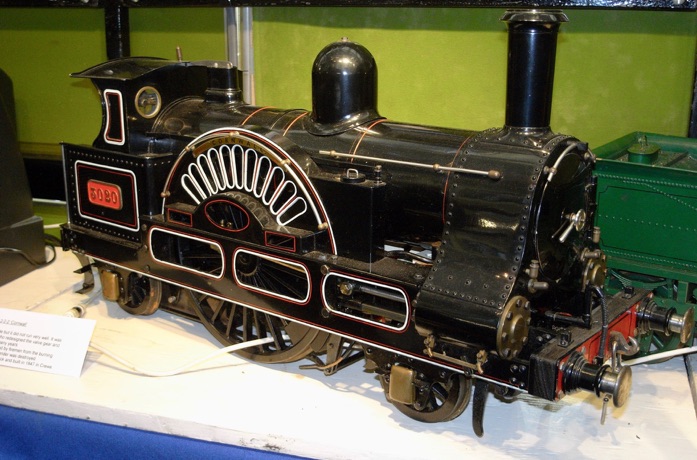
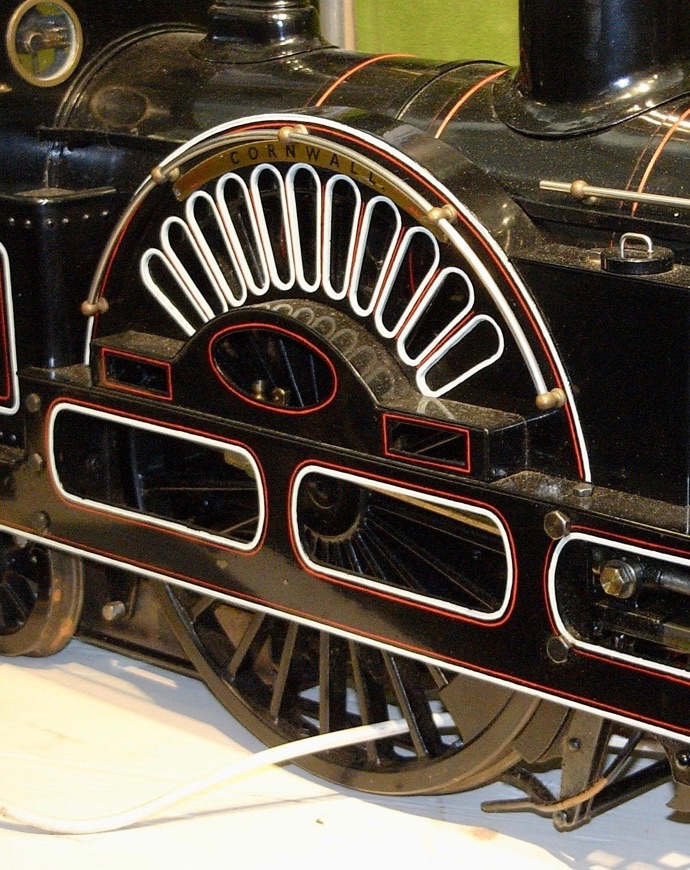
This model was originally built in the 1950s by Arthur Pole and later acquired by John Richardson who re-designed the valve gear. It survived a fire, being snatched from a burning workshop by firemen. Unfortunately, the tender was destroyed.
The original loco is preserved. It was built at Crewe Works in1847 and revised in 1858. The design was focused on the need for single large-diameter driving wheels of around 8 ft (2.4 m). The large driving wheels delivered the high linear tyre speed needed for fast locomotives, while keeping the axle bearing and piston speeds low enough to remain within the limits of the existing technology. Later on, increasing engine power would require better adhesion than a single pair of driving wheels could provide, but that was not a problem at the time.
Designer was Francis Trevithick, son of Cornish engineer Richard Trevithick. Francis had moved north to become resident engineer, then locomotive superintendent of the Grand Junction Railway (GJR) (later formed into the LNWR). In 1858, Ramsbottom redesigned Cornwall almost completely. Little survived unchanged, other than the outside frames and the centres of the drivers.