
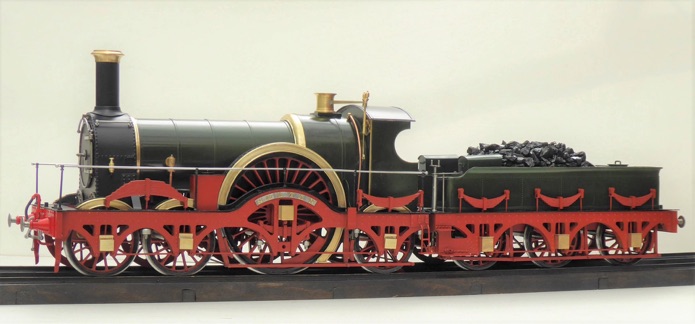
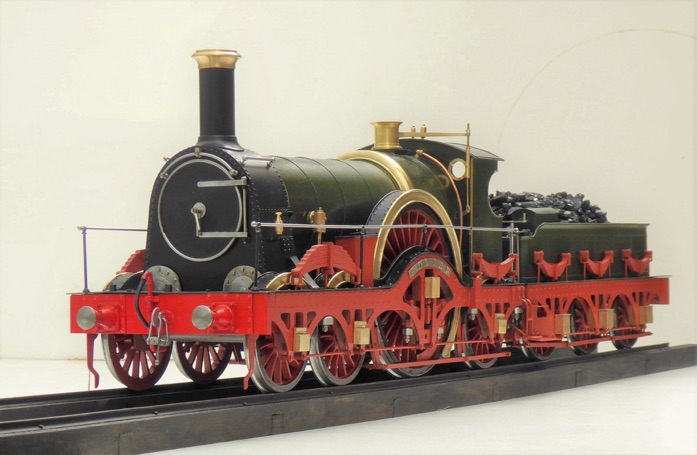
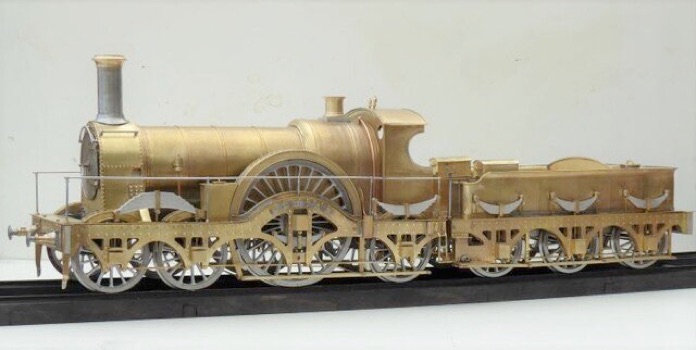
For those who have been intrigued by Brunel’s Broad Gauge, it is a surprise that, apart from members of the Broad Gauge Society, there are few who model the subject which is a pity as the later engines are magnificent. The Rover Class loco is a suitable Broad Gauge subject to model.
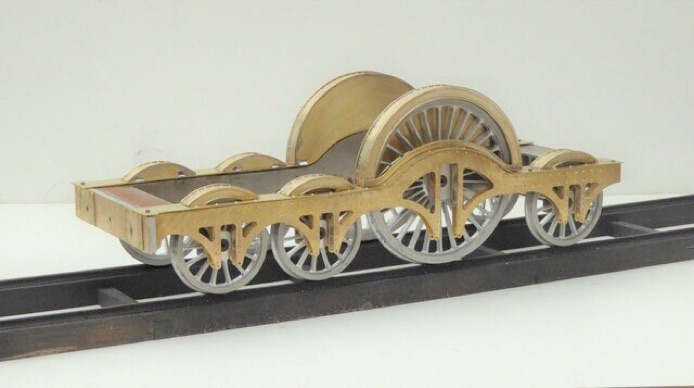
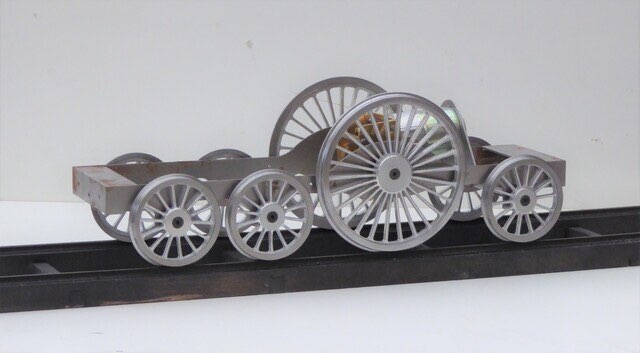
There are few suitable parts available in G3 so this model is entirely scratch built, using a CNC milling machine to cut all the parts. Construction started with the chassis and wheels then the boiler and smokebox followed by the cab, the tender and spray painting the model. The last part is the back head with its very fine detail.
In 1870, three Iron Duke class locomotives (also known as the Alma Class) were extensively rebuilt with new frames and boilers. Further locomotives were built to similar specifications, entering service between August 1871 and July 1888 and are known as the Rover class and were the last of the magnificent GWR broad garage engines.
The prototype locomotive, Great Western, was built as a 2-2-2 locomotive in April 1846, but was soon converted to a 4-2-2 arrangement, with the leading wheels set rigidly within the sandwich framing, rather than in a separate bogie. Locomotives of the Iron Duke class were fast for their time and were recorded reaching 78.2 mph . They were used to haul the Flying Dutchman express train which, for several decades, was the world's fastest train. In 1852 the daily service from London Paddington to Exeter (194 miles or 312 km) was achieved with an average speed of 53 mph (85 km/h).
Lord of the Isles, the last Iron Duke class loco to be withdrawn, was initially preserved by the GWR at Swindon Works, but was scrapped in January 1906 owing to the pressure of space.
Nameplates can be seen at the National Railway Museum and at Swindon Steam Railway Museum along with the driving wheels from Lord of the Isles.
In 1985 a working replica of Iron Duke was constructed using parts from two Hunslet Austerity tanks as part of the 'Great Western 150' celebrations. It is part of the National Railway Collection on long-term loan to the Didcot Railway Centre, which has a section of working broad gauge track.





Modelengineeringwebsite.com
the only free and the only weekly magazine for model engineers.
Editor: David Carpenter