
JUNG LOCO GIVEN
NEW LIFE
Neal and Nigel Davis

The Jung is a 7¼” gauge model of a 2’ gauge locomotive. It is an 0-6-2 superheated tank design, built to the 3’6” loading gauge; which meant they were very big on 2’ foot gauge, and very powerful. However, it is a very close scale model of a real locomotive made by the German company, Jung. Jung built hundreds of steam locomotives in many gauges, including main line, but they specialized in narrow gauge for industry.
This locomotive was built, along with sixteen others, all identical, for the Otavi mine railways in South Africa. This railway was famous as the longest 2’ gauge railway in the world, covering over 300 miles of track and joining up various coal mines with coastal ports. Later, when the mines closed, the railway became a passenger line, which led to two locomotives having huge water tenders made, as the distances between stations was far greater than between the mines. In the 1970s the railway was converted to their standard gauge (3’6" in Africa) and is part of the national complex.
At least two locomotives have been preserved in Africa, which is how the model came to be built. The builder, a Mr. Alan Wesley-Millar was a member of the Taunton model engineering society in the late 1970s, and was a fairly prolific model builder.
Alan had a good friend who, as a hobby, toured the world looking for rare and unusual railways. This chap also made drawings of interesting locomotives and took a lot of pictures. When he returned to England he drew up a complete set of working drawings for the Jung he had found in Africa, and built this most unusual and unique scale model.
That was in 1981. Shortly after it was built, it won a prestigious award at a Southern Federation Model Engineering Exhibition, in Bristol. After a couple of years running at the Taunton model engineering club, it was sold to a commercial enterprise in North Wales.
The commercial enterprise ran the loco, pulling passenger trains until they wore it out, and they then sold it on to a dealer who tidied it up and resold it on to a private buyer. This person dismantled the loco completely and set about restoring it; but sadly, he passed away before it was finished.
Finally, it was acquired by another dealer in Leeds at auction, as a set of parts, with the intention of rebuilding it and selling it on. This dealer then discovered that a lot of the model was missing, and realized that they could not economically restore it, so it was put up for sale as incomplete, which is where I came in.
I have been building and running model steam all my life, but mostly smaller scales. I had decided to move up to a bigger scale so I could ride in the model rather than on it. (This is an age thing, as running the little locos requires a certain amount of agility). The 7¼” gauge is very popular with clubs and is big enough to do serious passenger hauling, but the downside is it is expensive, with ready-made locos costing between £20,000 and £40,000. Building your own, if you have the equipment to do so, can still cost upwards of £10,000. (The piece of copper just to make the boiler outer tube will set you back £750 and then you have to buy all the boiler tubes etc.).
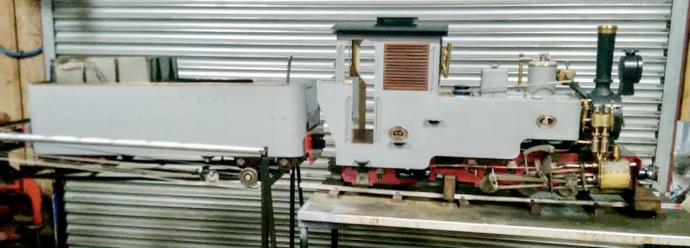
So, when I saw this loco for sale at a knockdown price, I went to see it. The model is very nicely built and the boiler was in near perfect condition, but it was all in pieces and most of the left side running gear, brackets, piston, con rods and valves were missing. Various parts of the body had been damaged over time, but it did have the big tender complete and undamaged. However, as the missing parts were mainly the engineered bits from steel (or so it seemed initially) and I could copy the right side components, it was, to me, an extremely attractive proposition.
So, I bought it.
Many hours on the milling machine made all the missing crosshead, coupling rods, connecting rods, piston and valve gear for the left side. The chassis was then stripped and repainted and also some finishing, as this appeared to have been remade as part of the former restoration.
The model has an interesting arrangement of sliding collars on the axles, so it can be quickly converted to run on 7¼” or 5"gauge track, although I would hesitate to run so large a model on raised track!
As the model had been intended to do serious work, it was fitted with a steam operated band brake on the rear driving axle. This brake was worn out so I redesigned it, converting it to a disc brake (the little disc calipers now available for bicycles are extremely efficient and cheap from Halfords, all you have to make is a new smaller disc, I have used these before on petrol electric locos).
I then carried out a repaint of the chassis before reassembling all the running gear. Also, while the boiler was out, I brought it to the club and we tested and certified the boiler, which passed with flying colours. The initial re-build consisted of mounting the boiler and fitting the superstructure, while simultaneously repairing and painting the superstructure.
This proved quite time consuming as many of the fittings were missing and we had no plans, so a sort of ‘evidence based’ rebuild began, using experience to fit the many small and interesting bits found in the box that came with it. Most of the pipework was either badly bent or missing so most was re-piped with new.
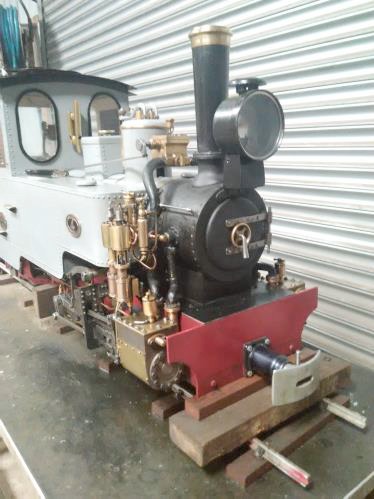

Some technical stuff, boiler pressure is 80lbs per square inch, cylinders are 2” by 2½” stroke giving a tractive effort of around 700 lbs. This is colossal for a 7¼” model. Being a German design, it has all the external complexity that you don’t see on British locos, plus lots of brass to polish! Another nice touch is the huge headlight which is a fully working oil lamp. It burns for about 20 minutes on a fill but is pretty inefficient in model form.
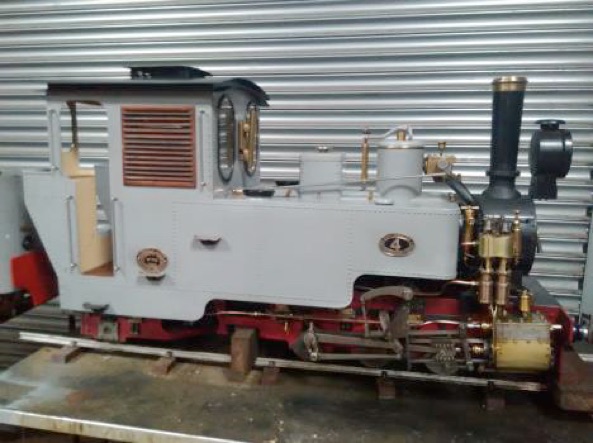
The model is now completely finished and the fact that all this has been done since Christmas, 2019, is entirely due to coronavirus. The model is magnificent. Being narrow gauge it is big, in fact it is about 1:4 scale, and it weighs in at around 4 cwt; so I have also built an electric lift to get it into the pickup and down onto the track.
Probably the lesson learned here was that it seemed, in the first instance, to be a bargain, but there was far more missing than the dealer declared, and also a lot of the parts were damaged or worn out. However, luckily, the all copper boiler was extremely well made and in excellent condition, so I probably got my money’s worth in that alone. I don’t think this was a deliberate attempt to mislead, but just a case that the dealer himself had no information on the model, so it was really just a case of a bit of a gamble. On the upside, under the paint, the whole superstructure is made from substantial brass plate, so no expense spared by the original builder.
Now, all I have to do is either complete my garden railway or wait until the model club re-opens to take it for its steam test to complete the boiler certificate and finally have a play!




Modelengineeringwebsite.com
the only free and the only weekly magazine for model engineers.
Editor: David Carpenter