SIMPLE HOBBING
By Phil Drake


SIMPLE HOBBING
By Phil Drake

I have had a lifelong interest in model railways especially 0-gauge coarse scale, three rail, electric. Over the years I have built and developed an extensive layout in the garden; I scratch build locomotives, rolling stock, track points and analogue electrical control equipment. All my locomotives require DC motors along with worm and worm wheel drives. I have collected several motors over the years, and most have worms but no worm wheels.
I learned of hobbing from the internet in my search for worm wheels. As I also had two Meccano worms that I could use, I asked guys at the Bournemouth club if I could borrow an appropriate 9/16” tap to cut the wheels. This request triggered interest and hence this article.
The process is very simple. The appropriate size tap is set in the lathe chuck or collet and supported by the tailstock. A suitable blank on a sturdy vertical spindle mounted on the cross slide is fed against the slowly rotating tap. The result is a worm wheel with a matching form to the tap.
The diameter (D) of the worm wheel blank can be deduced from the product of the number of teeth required (i.e. the ratio to the worm) with the thread pitch of the worm, divided by pi.
So, for a 12mm diameter worm with a pitch of 1.75mm requiring a ratio of 30:1 the equation is:-
D = (30 x 1.75) / 3.142
= 16.7 mm.
The result is a worm wheel with a matching form to the tap.
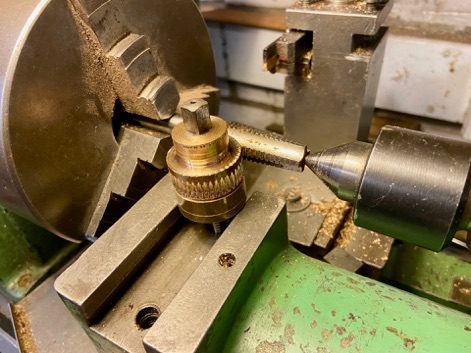
Doing the process for the first time I was uncertain how sturdy the spindle would need to be. As can be seen in the photo, my old Fortis lathe has two holes tapped 3/8” Whitworth in its cross slide. I utilized one of these to support my blank on a 3/8” Whit. Tap, (Note: tap shanks need to be checked for diameter).
This did mean, however, that I would have to make the worm wheel in two parts as I use 3/16” diameter axles. Thus, I inserted a 3/8” arbor into the blank, first boring it 3/16” but ensuring concentricity throughout the process.
I also manufactured two different sized wheels on the one blank. I intend to try the process again using a 3/16” spindle set in a length of square section bar held in my tool post tool holder.
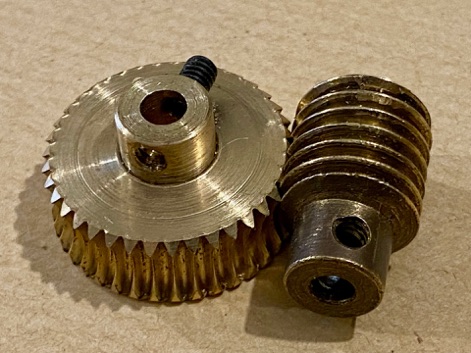
The photographs below illustrate the machined blank and the finished wheels. The worms themselves, of course, are an exercise in screw cutting.







Modelengineeringwebsite.com
the only free and the only weekly magazine for model engineers.
Editor: David Carpenter